Marketing strategy

Feb 2, 2026

How to Choose the Right Marketing Channels for Your Business

How to Choose the Right Marketing Channels for Your Business

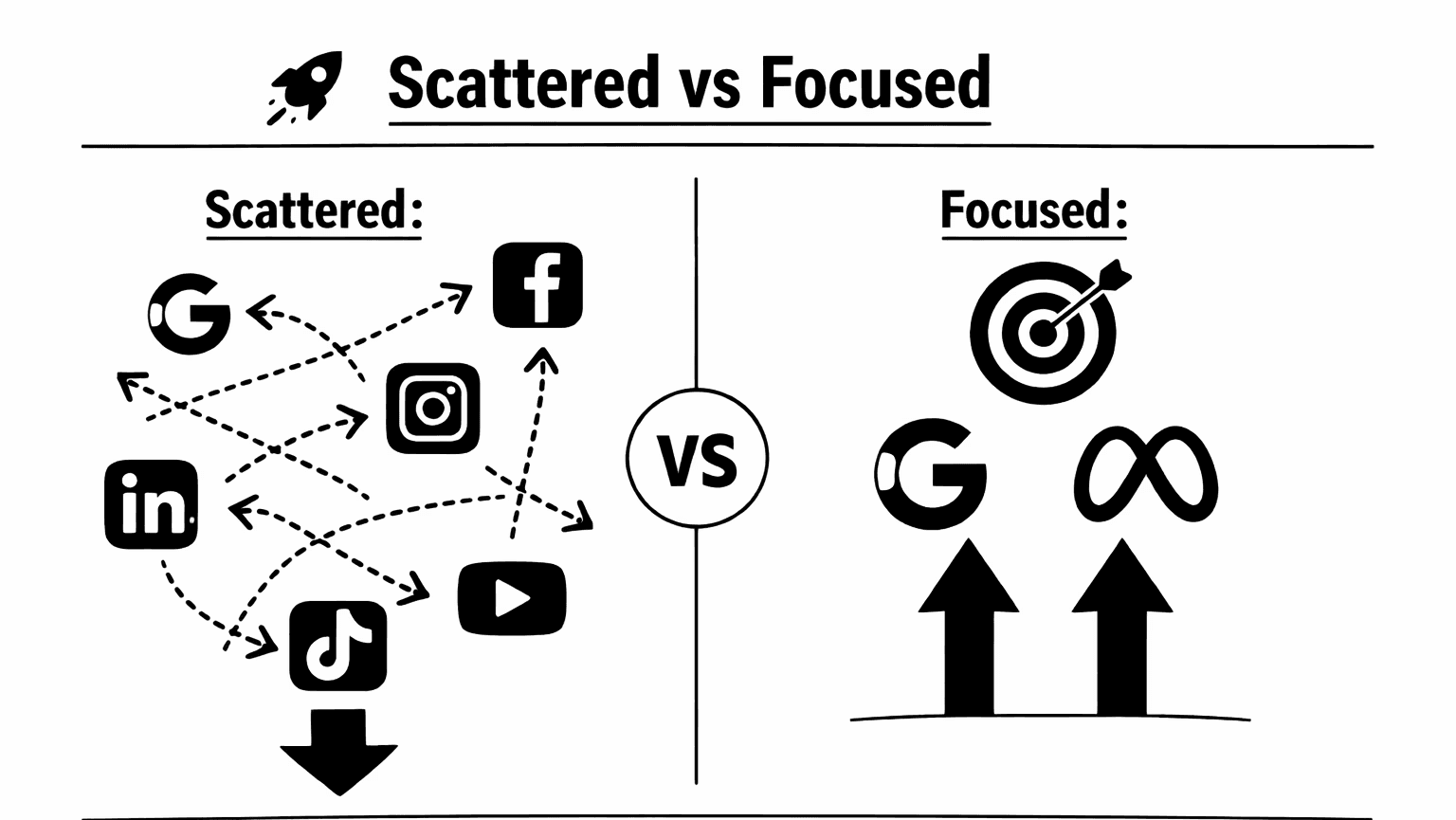
Scattered vs focused ads

A practical framework from 15 years of managing Google Ads and Meta Ads

After 15 years of managing Google Ads and Meta Ads for businesses, I've learned one thing:

The brands that win aren't on every platform. They're on the RIGHT platforms.

Yet most businesses I speak to are doing the opposite—spreading their budgets across Google, Meta, LinkedIn, TikTok, and YouTube simultaneously, hoping something sticks.

The result? Diluted budgets, inconsistent creative, confused attribution, and teams stretched too thin to optimise anything properly.

In this guide, I'll share the exact framework I use with my clients to identify and prioritise the marketing channels that actually move the needle.


Why Most Businesses Get Channel Selection Wrong

There's a persistent belief that you need to be present on every platform where your customers might be. While this sounds logical, it ignores a fundamental reality:

Each channel requires dedicated resources, unique creative, and sufficient budget to generate meaningful data.

When you spread across six platforms with a budget suited for two, you end up average everywhere and great nowhere.

The platforms themselves encourage this behaviour. Their sales teams are incentivised to get you spending—regardless of whether their platform is the right fit for your business.


The 6-Step Framework for Choosing Marketing Channels

1. Start With Your Customer, Not the Platform

This seems obvious, but it's where most businesses go wrong. They ask "Which platforms should we be on?" instead of "Where does our customer actually spend time?"

Key questions to answer:

  • Where does your target audience spend their online time?

  • What content formats do they engage with?

  • How do they research products in your category?

  • What's their typical purchase journey length?

Practical examples:

A B2B software company selling to CFOs has no business putting serious money into Instagram. Their audience isn't scrolling Instagram to find enterprise software—they're searching Google and networking on LinkedIn.

A fashion D2C brand targeting Gen Z women shouldn't lead with LinkedIn. Their audience discovers new brands through Instagram Reels and TikTok.

Sounds basic. But you'd be surprised how many brands pick channels based on trends rather than genuine customer behaviour.

2. Give Each Channel ONE Clear Job

Every platform has a natural strength. Problems arise when you expect a channel to do something it wasn't designed for.

Channel roles at a glance:

Channel

Primary Strength

Google Search

Capture people actively looking for your product

Meta/Instagram

Reach new audiences who don't know you yet

YouTube

Build trust through longer educational content

Email

Nurture leads and retain existing customers

LinkedIn

B2B lead generation and thought leadership

TikTok

Brand discovery among younger demographics

The mistake to avoid:

Expecting Meta to deliver the same cost-per-acquisition as Google Search. These channels serve different parts of the funnel.

Meta introduces your brand to cold audiences who weren't looking for you. Google captures people who are actively searching.

When you judge Meta by Google Search metrics, you'll always be disappointed—and you might cut the very channel that's filling your funnel at the top.

3. Match Your Budget to Your Resources

A channel is only as good as your ability to execute it well.

This includes:

  • Creative production capacity: Can you produce enough quality ads for this platform?

  • Platform expertise: Do you or your team know how to optimise here?

  • Testing budget: Do you have enough spend to generate statistically significant data?

  • Management time: Can you actively manage and optimise campaigns?

The harsh reality:

Running 5 platforms with thin budgets and no dedicated creative resources means you'll be average everywhere.

I'd rather see a brand absolutely dominate 2 channels than struggle across 6. Depth beats breadth, especially when you're building your marketing foundation.

4. Understand the True Cost—Not Just Ad Spend

Every channel has hidden costs beyond the advertising spend itself.

Hidden costs to factor in:

Creative Production Meta and TikTok require constant creative refreshes—sometimes weekly for high-spend accounts. Video platforms need production investment. Each platform has unique format requirements.

Landing Page Requirements Google Ads performs best with dedicated, optimised landing pages. Different campaigns may need different experiences.

Learning and Testing Budget Every new channel requires a learning phase where you're essentially paying for data. Expect 20-30% of your first quarter's budget to go toward testing.

Time to Results SEO and content marketing take 6-12 months to show meaningful results. Paid search can show results within days. Meta prospecting campaigns typically need 2-4 weeks to optimise.

Factor all of this before committing to a new channel.

5. Fix Attribution Before Scaling

This is where most brands get stuck—and where the most money gets wasted.

The attribution problem:

Your Google Ads dashboard shows 5x ROAS. Meta shows 2x ROAS. Logically, you should shift budget from Meta to Google, right?

Not so fast.

Here's what might actually be happening:

Meta introduced the customer to your brand through a prospecting ad. They didn't purchase immediately. Three days later, they searched your brand name on Google, clicked an ad, and bought.

Google gets 100% of the credit in last-click attribution. Meta appears to have contributed nothing.

But without that initial Meta ad, the customer would never have searched for you.

Why this matters:

If you cut Meta budget based on this misleading data, you'll see short-term improvement in efficiency followed by a gradual decline in results—because nothing is feeding your funnel anymore.

I've seen this pattern repeatedly. Brands cut their "underperforming" prospecting channels, enjoy 2-3 months of better-looking numbers, then wonder why everything suddenly stops working.

Better approaches:

  • Use blended metrics (total revenue ÷ total spend) alongside platform metrics

  • Look at incrementality testing to understand true channel contribution

  • Pay attention to correlation: when you increase Meta spend, does branded search volume increase too?

6. Why Experienced Marketers Matter Here

The platforms have made it incredibly easy to launch campaigns. You can go from zero to running ads in under an hour.

But easy to launch doesn't mean easy to succeed.

The uncomfortable truth:

The algorithms are optimised for the platform's goals, not your profit margins. Meta wants you to spend more on Meta. Google wants you to spend more on Google.

Their "automated recommendations" often align with their revenue goals, not yours.

What experience provides:

  • Pattern recognition across hundreds of campaigns—knowing what works before testing everything from scratch

  • Knowing when the data is misleading—raw numbers rarely tell the whole story

  • Understanding which metrics matter for YOUR business—ROAS looks great, but are you actually profitable after product costs and returns?

  • Spotting channel overlap and cannibalisation—sometimes your channels compete with each other rather than working together

In a world where everyone has access to the same tools, strategic thinking becomes the real competitive advantage.


My Practical Approach: Putting It Together

Here's the condensed framework:

Start focused: Begin with 2 proven channels that match your customer's behaviour. For most D2C brands, this is Google and Meta.

Build foundation first: Get proper tracking and attribution in place before scaling spend. You cannot optimise what you cannot measure.

Test methodically: Add one new channel at a time with clear success metrics defined upfront. Give each test enough budget and time to generate meaningful data.

Review quarterly: Which channels are delivering? Where can you scale? What should you test next? What should you cut?


Common Mistakes to Avoid

Chasing shiny objects: A new platform launches and suddenly you want to shift strategy. Consistency and depth typically outperform constant pivoting.

Cutting too quickly: Channels need time to optimise. Cutting after 2 weeks rarely gives accurate information about potential.

Ignoring creative quality: No amount of targeting sophistication compensates for poor creative. Invest in creative development alongside media buying.

Over-relying on platform recommendations: Google and Meta will constantly suggest you expand and increase budgets. These suggestions serve their revenue goals. Evaluate critically.


Conclusion

Choosing the right marketing channels isn't about finding a secret platform or hack. It's about disciplined thinking:

  • Understanding your customer deeply

  • Matching channels to their behaviour and your resources

  • Setting clear expectations for each channel's role

  • Measuring accurately and adjusting based on real data

  • Having the patience to let strategies develop

Being everywhere is not a strategy. Being in the right places with the right message—that's what drives sustainable growth.


Need Help With Your Channel Strategy?

If you're running Google Ads or Meta Ads and want expert guidance on your marketing channel mix, I can help. With 15 years of experience managing performance marketing for D2C and B2B brands, I help businesses identify which channels deserve their investment and how to maximise returns.


A practical framework from 15 years of managing Google Ads and Meta Ads

After 15 years of managing Google Ads and Meta Ads for businesses, I've learned one thing:

The brands that win aren't on every platform. They're on the RIGHT platforms.

Yet most businesses I speak to are doing the opposite—spreading their budgets across Google, Meta, LinkedIn, TikTok, and YouTube simultaneously, hoping something sticks.

The result? Diluted budgets, inconsistent creative, confused attribution, and teams stretched too thin to optimise anything properly.

In this guide, I'll share the exact framework I use with my clients to identify and prioritise the marketing channels that actually move the needle.


Why Most Businesses Get Channel Selection Wrong

There's a persistent belief that you need to be present on every platform where your customers might be. While this sounds logical, it ignores a fundamental reality:

Each channel requires dedicated resources, unique creative, and sufficient budget to generate meaningful data.

When you spread across six platforms with a budget suited for two, you end up average everywhere and great nowhere.

The platforms themselves encourage this behaviour. Their sales teams are incentivised to get you spending—regardless of whether their platform is the right fit for your business.


The 6-Step Framework for Choosing Marketing Channels

1. Start With Your Customer, Not the Platform

This seems obvious, but it's where most businesses go wrong. They ask "Which platforms should we be on?" instead of "Where does our customer actually spend time?"

Key questions to answer:

  • Where does your target audience spend their online time?

  • What content formats do they engage with?

  • How do they research products in your category?

  • What's their typical purchase journey length?

Practical examples:

A B2B software company selling to CFOs has no business putting serious money into Instagram. Their audience isn't scrolling Instagram to find enterprise software—they're searching Google and networking on LinkedIn.

A fashion D2C brand targeting Gen Z women shouldn't lead with LinkedIn. Their audience discovers new brands through Instagram Reels and TikTok.

Sounds basic. But you'd be surprised how many brands pick channels based on trends rather than genuine customer behaviour.

2. Give Each Channel ONE Clear Job

Every platform has a natural strength. Problems arise when you expect a channel to do something it wasn't designed for.

Channel roles at a glance:

Channel

Primary Strength

Google Search

Capture people actively looking for your product

Meta/Instagram

Reach new audiences who don't know you yet

YouTube

Build trust through longer educational content

Email

Nurture leads and retain existing customers

LinkedIn

B2B lead generation and thought leadership

TikTok

Brand discovery among younger demographics

The mistake to avoid:

Expecting Meta to deliver the same cost-per-acquisition as Google Search. These channels serve different parts of the funnel.

Meta introduces your brand to cold audiences who weren't looking for you. Google captures people who are actively searching.

When you judge Meta by Google Search metrics, you'll always be disappointed—and you might cut the very channel that's filling your funnel at the top.

3. Match Your Budget to Your Resources

A channel is only as good as your ability to execute it well.

This includes:

  • Creative production capacity: Can you produce enough quality ads for this platform?

  • Platform expertise: Do you or your team know how to optimise here?

  • Testing budget: Do you have enough spend to generate statistically significant data?

  • Management time: Can you actively manage and optimise campaigns?

The harsh reality:

Running 5 platforms with thin budgets and no dedicated creative resources means you'll be average everywhere.

I'd rather see a brand absolutely dominate 2 channels than struggle across 6. Depth beats breadth, especially when you're building your marketing foundation.

4. Understand the True Cost—Not Just Ad Spend

Every channel has hidden costs beyond the advertising spend itself.

Hidden costs to factor in:

Creative Production Meta and TikTok require constant creative refreshes—sometimes weekly for high-spend accounts. Video platforms need production investment. Each platform has unique format requirements.

Landing Page Requirements Google Ads performs best with dedicated, optimised landing pages. Different campaigns may need different experiences.

Learning and Testing Budget Every new channel requires a learning phase where you're essentially paying for data. Expect 20-30% of your first quarter's budget to go toward testing.

Time to Results SEO and content marketing take 6-12 months to show meaningful results. Paid search can show results within days. Meta prospecting campaigns typically need 2-4 weeks to optimise.

Factor all of this before committing to a new channel.

5. Fix Attribution Before Scaling

This is where most brands get stuck—and where the most money gets wasted.

The attribution problem:

Your Google Ads dashboard shows 5x ROAS. Meta shows 2x ROAS. Logically, you should shift budget from Meta to Google, right?

Not so fast.

Here's what might actually be happening:

Meta introduced the customer to your brand through a prospecting ad. They didn't purchase immediately. Three days later, they searched your brand name on Google, clicked an ad, and bought.

Google gets 100% of the credit in last-click attribution. Meta appears to have contributed nothing.

But without that initial Meta ad, the customer would never have searched for you.

Why this matters:

If you cut Meta budget based on this misleading data, you'll see short-term improvement in efficiency followed by a gradual decline in results—because nothing is feeding your funnel anymore.

I've seen this pattern repeatedly. Brands cut their "underperforming" prospecting channels, enjoy 2-3 months of better-looking numbers, then wonder why everything suddenly stops working.

Better approaches:

  • Use blended metrics (total revenue ÷ total spend) alongside platform metrics

  • Look at incrementality testing to understand true channel contribution

  • Pay attention to correlation: when you increase Meta spend, does branded search volume increase too?

6. Why Experienced Marketers Matter Here

The platforms have made it incredibly easy to launch campaigns. You can go from zero to running ads in under an hour.

But easy to launch doesn't mean easy to succeed.

The uncomfortable truth:

The algorithms are optimised for the platform's goals, not your profit margins. Meta wants you to spend more on Meta. Google wants you to spend more on Google.

Their "automated recommendations" often align with their revenue goals, not yours.

What experience provides:

  • Pattern recognition across hundreds of campaigns—knowing what works before testing everything from scratch

  • Knowing when the data is misleading—raw numbers rarely tell the whole story

  • Understanding which metrics matter for YOUR business—ROAS looks great, but are you actually profitable after product costs and returns?

  • Spotting channel overlap and cannibalisation—sometimes your channels compete with each other rather than working together

In a world where everyone has access to the same tools, strategic thinking becomes the real competitive advantage.


My Practical Approach: Putting It Together

Here's the condensed framework:

Start focused: Begin with 2 proven channels that match your customer's behaviour. For most D2C brands, this is Google and Meta.

Build foundation first: Get proper tracking and attribution in place before scaling spend. You cannot optimise what you cannot measure.

Test methodically: Add one new channel at a time with clear success metrics defined upfront. Give each test enough budget and time to generate meaningful data.

Review quarterly: Which channels are delivering? Where can you scale? What should you test next? What should you cut?


Common Mistakes to Avoid

Chasing shiny objects: A new platform launches and suddenly you want to shift strategy. Consistency and depth typically outperform constant pivoting.

Cutting too quickly: Channels need time to optimise. Cutting after 2 weeks rarely gives accurate information about potential.

Ignoring creative quality: No amount of targeting sophistication compensates for poor creative. Invest in creative development alongside media buying.

Over-relying on platform recommendations: Google and Meta will constantly suggest you expand and increase budgets. These suggestions serve their revenue goals. Evaluate critically.


Conclusion

Choosing the right marketing channels isn't about finding a secret platform or hack. It's about disciplined thinking:

  • Understanding your customer deeply

  • Matching channels to their behaviour and your resources

  • Setting clear expectations for each channel's role

  • Measuring accurately and adjusting based on real data

  • Having the patience to let strategies develop

Being everywhere is not a strategy. Being in the right places with the right message—that's what drives sustainable growth.


Need Help With Your Channel Strategy?

If you're running Google Ads or Meta Ads and want expert guidance on your marketing channel mix, I can help. With 15 years of experience managing performance marketing for D2C and B2B brands, I help businesses identify which channels deserve their investment and how to maximise returns.

Ready to transform your brand?

Let’s create something incredible together!

Ready to transform your brand?

Let’s create something incredible together!

Ready to transform your brand?

Let’s create something incredible together!