The bilingual opportunity most D2C brands miss
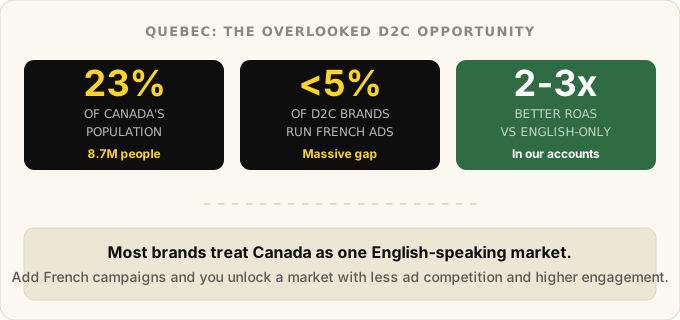
Canada is officially bilingual. Roughly 22% of the population speaks French as a first language, concentrated in Quebec (8.5 million people) but also present in New Brunswick, Ontario, and Manitoba. Quebec alone represents about 23% of Canada's GDP.
For D2C ecommerce brands running Google Ads in Canada, the default approach is English-only campaigns targeting the entire country. This works — until you look at the data from brands that run dedicated French-language campaigns alongside English ones.
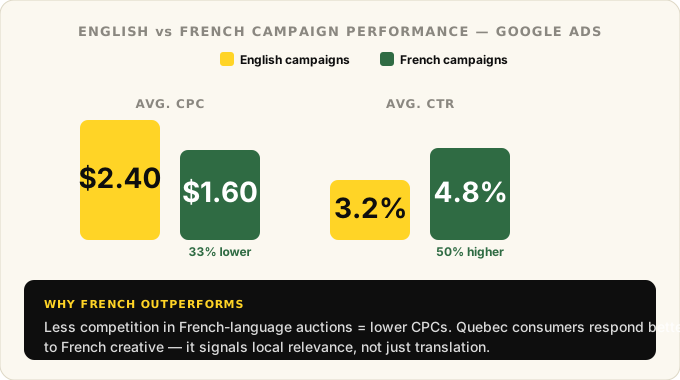
Across D2C accounts we've managed with Canadian targeting, French-language campaigns in Quebec consistently outperform English-language campaigns on three metrics: click-through rate, cost per click, and conversion rate. The reason is straightforward — there's less competition.
Why French campaigns outperform: the competition gap
Lower CPCs. Most advertisers — including major DTC brands — run English-only Google Ads in Canada. The French-language auction has fewer bidders. For the same product-category keywords, CPCs in French are typically 20–40% lower than their English equivalents.
Higher CTRs. When a French-speaking consumer in Quebec sees a Google ad in their language, it stands out. Most competing ads are in English. A well-written French ad with localized copy (not machine-translated) signals relevance and earns the click.
Better conversion rates. Quebec consumers who click a French ad and land on a French landing page convert at a higher rate than the same consumers clicking English ads. This isn't surprising — it's basic localization. But most brands don't do it, so the ones that do gain disproportionate advantage.
How to structure bilingual Google Ads campaigns
Separate campaigns, not ad groups. Run French and English as completely separate campaigns with separate budgets. This gives you independent bidding, budget control, and reporting. Mixing languages within a single campaign makes optimization impossible.
Geo-targeting
- English campaigns: target all of Canada, exclude Quebec (or let language setting handle it)
- French campaigns: target Quebec specifically
- For Montreal where both languages are common: run both and let Google's language matching sort it out
Keyword research for French campaigns
Don't just translate your English keywords. French search behavior differs:
- Word order and phrasing differ. "Best moisturizer for dry skin" doesn't translate word-for-word. Use Keyword Planner set to French/Quebec.
- Some categories use English terms in French contexts. Beauty consumers in Quebec often search product names in English but prefer French for generic category terms. Include both.
- Negative keywords need separate French lists. Your English negatives won't filter French irrelevant traffic.
- Match types behave the same but semantic matching in French is slightly less refined. Monitor Search Terms more frequently during the first 30 days.
Shopping and PMax for French-speaking Canada
Google Merchant Center: Your product feed needs French titles and descriptions for Shopping ads to serve in French. If your Shopify store supports French, generate a separate French feed. If not, create a supplemental feed with French translations.
- Create a separate PMax campaign for French-Quebec with French creative assets
- Set campaign language to French, geo to Quebec
- Apply brand exclusions (same as English PMax — see our ROAS post)
- French PMax tends to spend less aggressively — the auction is thinner. The efficiency is what matters.
Landing pages: localization vs. translation
This is where most brands fail. Running French ads that land on English pages kills conversion rate. You need French landing pages.
- Translate your top 5–10 landing pages (the ones your ads point to)
- Use hreflang tags to signal to Google which pages are English vs. French
- Subdirectory approach (/fr/product-name) is cleaner than subdomain for most Shopify setups
- Shopify Markets or a translation app like Weglot/Langify handles most of this
Measurement: comparing English vs. French
Track these metrics separately for EN-CA and FR-CA campaigns: Shopify-attributed revenue per campaign, CPA by language, ROAS by language (Shopify-attributed), and AOV by language.
In most D2C accounts we've seen, French campaigns deliver 20–35% lower CAC than equivalent English campaigns in Canada. The absolute volume is lower (Quebec is ~23% of population), but the efficiency makes it high-ROI.
Common mistakes to avoid
- Machine-translating ad copy. Google Translate produces grammatically correct but unnatural French. Quebec French has its own idioms. Have a native speaker write or review.
- Running French ads to English landing pages. The #1 conversion killer. If you can't build French pages, don't run French ads.
- Ignoring Quebec-specific holidays. Saint-Jean-Baptiste Day, specific school schedules — plan your promotional calendar accordingly.
- Treating Quebec as a test market. Quebec is Canada's second-largest economy. It deserves a dedicated strategy.
- Not running brand campaigns in French. Protect your brand searches in Quebec — competitors running French ads can intercept your traffic.
The bottom line
Adding French-language campaigns for Quebec is one of the highest-ROI moves a D2C brand can make in the Canadian market. The competition gap is real — fewer advertisers bidding in French means lower CPCs, higher CTRs, and better unit economics.
The work involved is meaningful (French creative, localized landing pages, separate campaign architecture) but the payoff is clear: 20–35% lower customer acquisition costs on a market that represents nearly a quarter of Canada's spending power.
Start with Search + Shopping in French, measure against your English benchmarks for 60 days, then expand to PMax. The numbers speak for themselves.