Why the UAE is a different paid-ads market
Most D2C playbooks are written for US brands selling to US consumers. The UAE breaks several of those assumptions.
The country has one of the highest smartphone penetration rates globally. Social media usage is near-universal. Instagram, TikTok, Snapchat, and YouTube all compete for attention — but the purchase behavior is different. UAE consumers are comfortable buying online, but they expect premium experiences, fast delivery (same-day or next-day is baseline), and they're more likely to abandon checkout over payment friction than over price.
For D2C brands running paid ads into the UAE, this means your funnel optimization priorities are different from day one.
The Meta Ads landscape in the UAE
Meta (Facebook + Instagram) remains the dominant prospecting channel for D2C ecommerce in the UAE. But the cost structure is different:
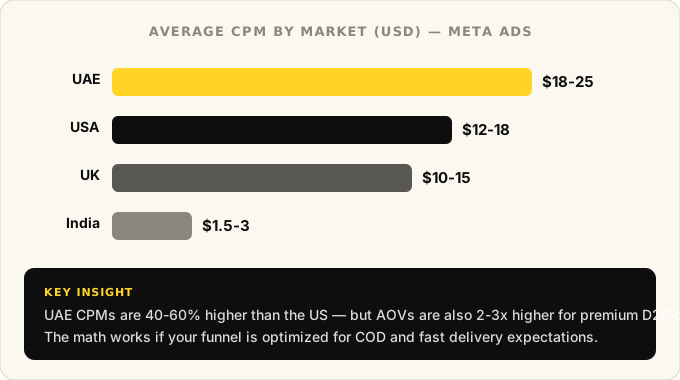
CPMs are higher than the US for most verticals. Beauty, skincare, and supplements — the core D2C verticals — typically see CPMs of $15–$35 on Meta in the UAE, compared to $8–$18 in the US. The audience is smaller (UAE population: ~10 million), so frequency builds faster and creative fatigue hits sooner.
What this means for campaign structure
- You need more creative variants per campaign than a US account. Plan for 8–12 ad variants per ad set, refreshed every 2–3 weeks.
- Broad targeting works better than detailed interest targeting. The audience is small enough that Meta's algorithm finds buyers faster with fewer constraints.
- Advantage+ Shopping Campaigns (ASC) perform well in the UAE because the total addressable audience is concentrated. In the US, ASC can waste budget on low-intent segments; in the UAE, there's less room to waste.
Language and creative considerations
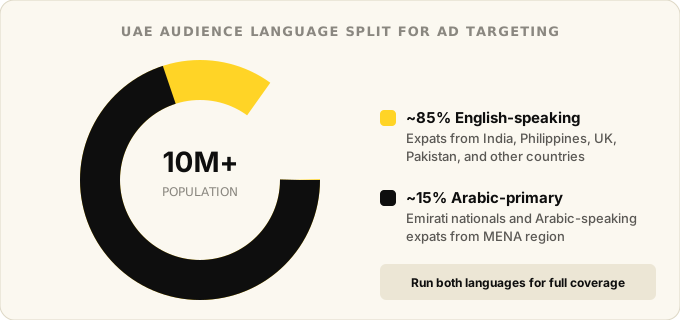
- The UAE is bilingual. English-language ads reach the expat population (~85% of residents). Arabic-language ads reach Emiratis and Arabic-speaking expats.
- Running both languages isn't optional if you want full market coverage. But don't just translate — cultural context matters. Lifestyle imagery, humor, and value propositions often need to be reworked, not just translated.
- Video outperforms static in the UAE across every vertical we've tested. Short-form (15–30 sec) for prospecting, UGC-style testimonials for retargeting.
The Andromeda Update — and why it matters even more in the UAE
In late 2024, Meta rolled out Andromeda — a new deep-learning retrieval engine that fundamentally changed how ads get matched to users. Before Andromeda, Meta's system evaluated thousands of candidate ads per impression. After Andromeda, it evaluates millions — using a neural network trained on the NVIDIA Grace Hopper Superchip to learn higher-order interactions between people and ad creative.
The result: +6% recall improvement in ad retrieval and +8% ads quality improvement across segments.
Andromeda replaced manual audience targeting with machine learning that matches ads based on creative signals, not demographic filters. Meta now officially recommends broad targeting with minimal audience constraints — because Andromeda's ML does the targeting work by reading your creative.
Why this hits harder in the UAE
- The UAE's total addressable audience is small (~10M). Pre-Andromeda, narrow targeting in a small market meant tiny reach and fast frequency buildup. Now, broad targeting + Andromeda's ML actually works better — the algorithm finds high-intent buyers without you specifying interest audiences.
- Creative diversity is now the primary performance lever. One perfect ad won't cut it. You need creative packs — 8–12 variants per campaign, mixing formats (static, video, UGC, carousel), refreshed every 2–3 weeks.
- Advantage+ Shopping Campaigns (ASC) are Andromeda's native environment. In the UAE, ASC + broad targeting + diverse creative is now outperforming manually targeted campaigns in almost every D2C account we manage.
Meta's Remarketing Power — the real moat
Meta's advantage over every other paid channel is its remarketing infrastructure. No other platform matches its ability to re-engage people who've interacted with your brand across surfaces.
- Cross-surface identity graph. Meta tracks users across Facebook, Instagram, Messenger, and WhatsApp (huge in the UAE). When someone views your product on Instagram, sees a story ad, then gets served a feed ad two days later — that's Meta's identity graph at work. Google can't do this across surfaces the same way.
- Dynamic Product Ads (DPA) for catalog retargeting. For D2C brands with 50+ SKUs, DPA automatically serves the exact products a user browsed — with real-time pricing and availability. In the UAE, DPA retargeting consistently delivers the highest ROAS of any campaign type.
- Custom audience depth. You can build retargeting audiences from video viewers (25%, 50%, 75% watched), Instagram engagers, website visitors by page/action, add-to-cart abandoners, and purchase history. No other platform gives you this level of granularity.
The catch (and why you still need Google): Meta's remarketing is powerful — but it's demand recycling, not demand creation. It converts people who already know you. The question is: where do those people come from in the first place?
Google's Closure Power — capturing high-intent demand
Google Ads is the closer. Meta creates awareness and desire. Google captures the moment someone is ready to buy.
When a UAE consumer sees your Meta ad, visits your site, browses a few products, and leaves — that's Meta doing its job. When that same consumer goes to Google two days later and searches "best vitamin C serum UAE" or "[your brand name] reviews" — that's the moment of purchase intent. Google captures that moment.
Why Google's closure power matters for D2C
- Search intent is commercial. Unlike Meta (where you interrupt people), Google users are actively looking for a solution. In the UAE market specifically, search intent runs even higher — consumers here are comparing options and ready to transact.
- Shopping Ads close the sale visually. When someone searches a product category, Google Shopping shows price, image, and reviews right in the SERP. Shopping Ads convert at 2–3× the rate of text Search ads.
- Brand Search captures Meta-generated demand. Every dollar you spend on Meta awareness creates brand searches on Google. Brand Search campaigns in the UAE are cheap (CPCs under $0.30) and convert at 8–15× ROAS.
The Meta → Google flywheel: This is the real play for D2C in the UAE. Meta creates demand through prospecting and remarketing. Google closes it through Shopping, non-brand Search, and brand Search. The brands that run both platforms as a system — not as independent channels — consistently outperform those that go Meta-only or Google-only.
Performance Max in the UAE
- Brand exclusions are critical (same as everywhere — see our ROAS post for why).
- PMax works well for discovery + Shopping surfaces in the UAE. YouTube placements within PMax over-index here because YouTube usage is very high in the region.
- Allocate 60–70% of Google budget to PMax with brand exclusions, 20–25% to non-brand Search, 10–15% to branded Search (to defend, not to scale).
Payment and checkout friction — the silent conversion killer
The biggest difference between running D2C ads in the UAE versus the US isn't the ad platform. It's what happens after the click.
Cash on Delivery (COD) is still significant. While credit card adoption has grown massively, a meaningful percentage of UAE consumers — especially outside Dubai and Abu Dhabi — still prefer COD.
- Offer Tabby or Tamara as a BNPL option. Conversion rate lift is typically 15–25% in the UAE.
- If your AOV is above 200 AED, BNPL becomes almost mandatory.
- Display payment options on the product page, not just at checkout. UAE consumers look for this before they add to cart.
- Same-day or next-day delivery in Dubai/Abu Dhabi is the benchmark. Make delivery timelines explicit in ads and on product pages.
Audience strategy: expats vs. nationals
The UAE's population is ~85% expatriates and ~15% Emirati nationals. These groups have very different purchasing behaviors.
Emirati consumers tend to have higher AOVs, stronger brand loyalty, and respond well to premium positioning. Arabic-language creative, influencer partnerships, and aspirational storytelling work here.
Expat consumers are price-sensitive, comparison-shop heavily, and respond to value-driven messaging, reviews, and social proof. English-language creative, discount-led hooks, and UGC perform well.
For most D2C brands, run separate ad sets (or campaigns) for each language, with creative and messaging tailored to each segment.
Measurement and attribution in the UAE
Everything in our ROAS reconciliation post applies here, but with one additional wrinkle: cross-device behavior in the UAE is extreme. Consumers commonly browse on mobile (often via Instagram or TikTok), then purchase on a different device.
- Always reconcile against Shopify Reports, not platform-reported ROAS.
- Install Meta Conversions API (CAPI) server-side. Browser-based pixel tracking under-reports by 20–40% in the UAE.
- Google Enhanced Conversions should be enabled for all accounts. First-party data matching recovers ~15% of lost conversions.
The bottom line
The UAE is a high-intent, high-CPM market where the brands that win run both Meta and Google as a flywheel, leverage Andromeda with diverse creative packs, use Meta's remarketing moat for mid-funnel nurture, let Google close high-intent searches, solve payment friction with BNPL and COD, produce bilingual creative, and reconcile against Shopify — not platform dashboards.
The opportunity is real — per-capita ecommerce spending in the UAE is among the highest in the world. But the playbook isn't copy-paste from the US. Adapt the fundamentals, and the unit economics work.